
The Game
You fly a low-flying interceptor over procedurally generated terrain, banking and climbing to bring a fixed forward cannon to bear on alien craft. Each world has ground installations the enemy is trying to bomb flat — lose them all and the run is over. Clear the skies and you warp onward to the next world, through a full cockpit cut-scene with engine spool, light-streaks, and re-entry.
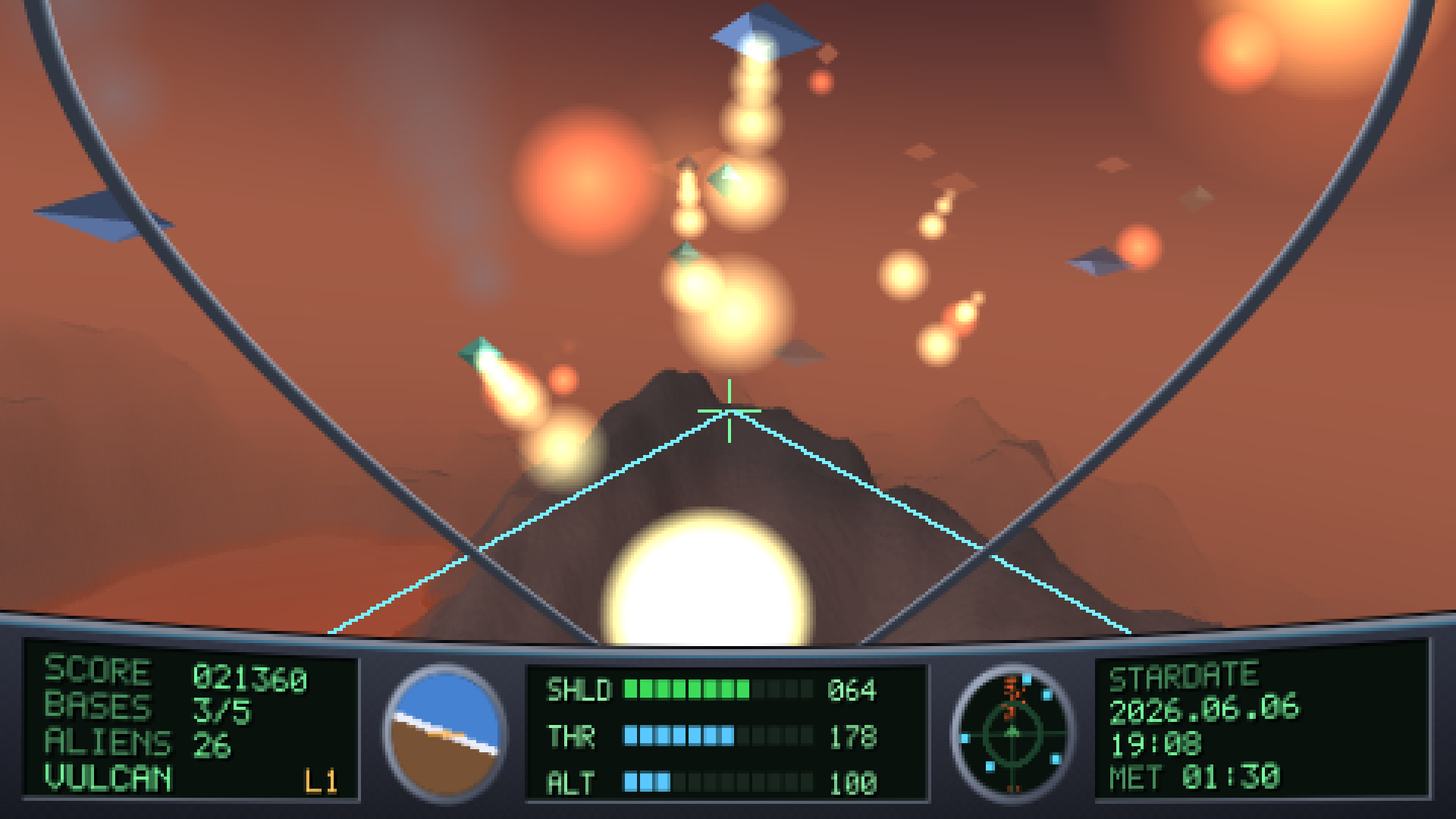
It’s an endless campaign over a finite, named cluster of colony worlds — Demeter, Tantalus, Boreas, Pandora, Vulcan, Vesper — cycled forever. Your level climbs without end and is the mark of how far you’ve pushed.
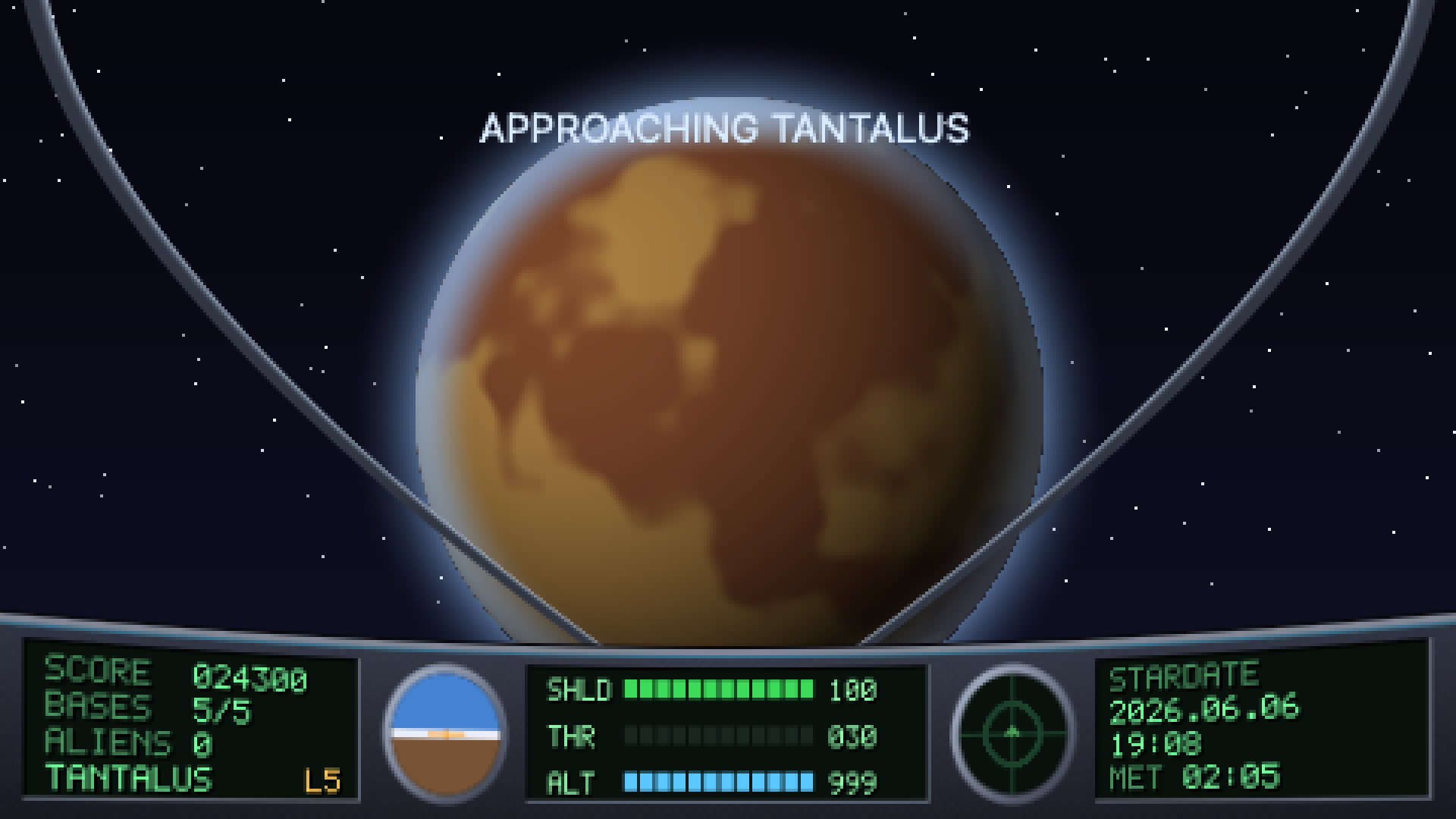
Warp Onward
Between worlds you leave the atmosphere, streak through hyperspace, and drop into the next planet’s gravity well — the cockpit instruments live the whole way through. The radar goes dark in transit (contact lost) and lights up again as the new colony resolves below.
Know Your Enemy
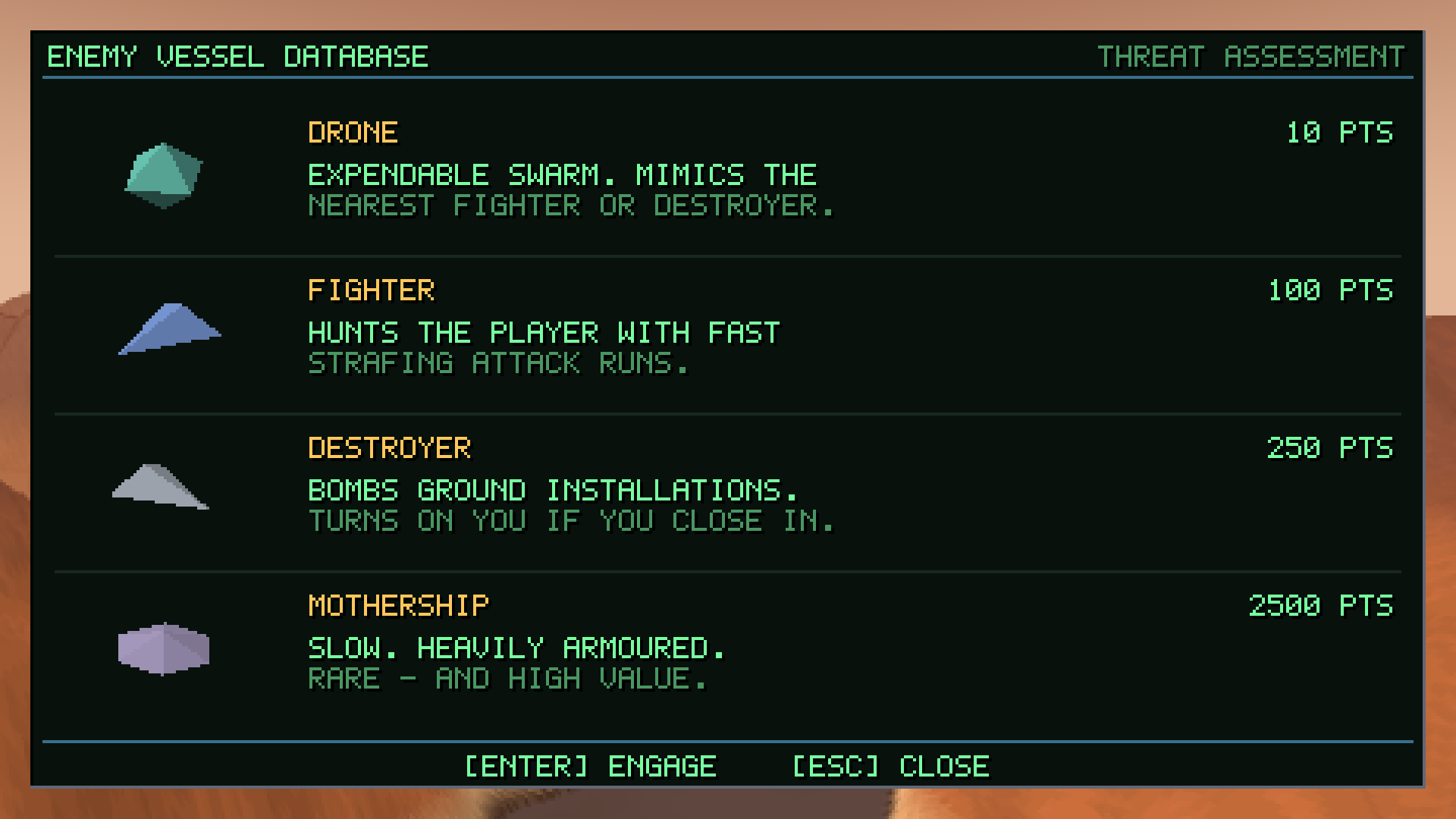
Four classes of attacker, each worth points. A rotating-3-D-model database (the enemy intel codex, reachable from the title screen) lays out the threat assessment:
| Vessel | Points | Behaviour |
|---|---|---|
| Drone | 10 | Expendable swarm. Mimics the nearest fighter or destroyer. |
| Fighter | 100 | Hunts the player with fast strafing attack runs. |
| Destroyer | 250 | Bombs ground installations; turns on you if you close in. |
| Mothership | 2,500 | Slow, heavily armoured. Rare — and high value. |
Power-Ups
Your level climbs forever, and as it does the ship earns combat upgrades — each unlocked at a milestone and carried with you from then on:
| Upgrade | Unlocks | What it does |
|---|---|---|
| 6 Degrees of Freedom | Level 3 | Full free-flight: roll and pitch through any attitude instead of simple banking turns — loop, roll and fly inverted. |
| Auto-Targeting Computer | Level 6 | Locks onto the nearest craft and bends your cannon fire onto the locked target, so a hit no longer needs the reticle dead-centre. |
| Cloaking Device | Level 9 | Tap to vanish — the enemy loses its lock and can’t track you for a few seconds. Recharges between uses. |
| Radial Pulse | Level 12 | A screen-clearing shockwave that obliterates every craft around you at once. Limited charges — spend them when you’re swamped. |
Keyboard Controls
| Key | Action |
|---|---|
| left / right | Steer (bank) |
| up / down | Climb / dive |
| + / − | Throttle |
| space | Fire |
| Z | Cloaking device (once unlocked) |
| X | Radial pulse (once unlocked) |
| R / return | Start · restart · warp (on the cleared-planet screen) |
| P | Pause |
| M | Mute |
| B / V | Mission briefing / enemy intel (from the title) |
| esc | Back (close briefing / codex) |
| C / K | Controller / keyboard setup |
| command, | Settings (audio, flight prefs, reset scores) |
| commandQ | Quit |
Every key is reconfigurable — the defaults above are just the starting layout; remap any of them from the Keyboard sheet (K).
A connected game controller (Xbox / DualShock / any Extended Gamepad) is detected automatically — the left stick steers and pitches, and the discrete actions (fire, throttle, pause, warp, cloak, pulse) are rebindable too, from the controller sheet. The keyboard always works as a fallback.
Everything From Maths
Strataris ships with zero asset files. No textures, no audio files, no 3-D models, no fonts — every pixel and every sound is generated in code:
- Terrain — seamless fractal-noise heightmaps, height-banded colour, slope shading and distance haze.
- Ships & installations — flat-shaded low-poly hulls and colony buildings (towers, domes, hangars, habitats), a handful of triangles each.
- Music & SFX — a from-scratch synthesiser with an original, long-form generative title theme.
- Radio voice comms — speech rendered offline and band-pass-filtered into a crackly cockpit-radio timbre, with squelch and roger bleeps.
- Fonts & particles — a 5×7 bitmap font for the HUD, plus smoke and fire for damaged installations.
The result is about 0.85 MB per architecture — smaller than the asset payload of many single web pages, and it fits on a 1.44 MB floppy with room to spare. Genuinely in the 16-bit spirit: demoscene-style “everything from maths,” running as a native Mac app. The world is a GPU triangle-mesh terrain rendered from a quaternion camera, composited with a hand-built 2-D cockpit and HUD.
High Scores
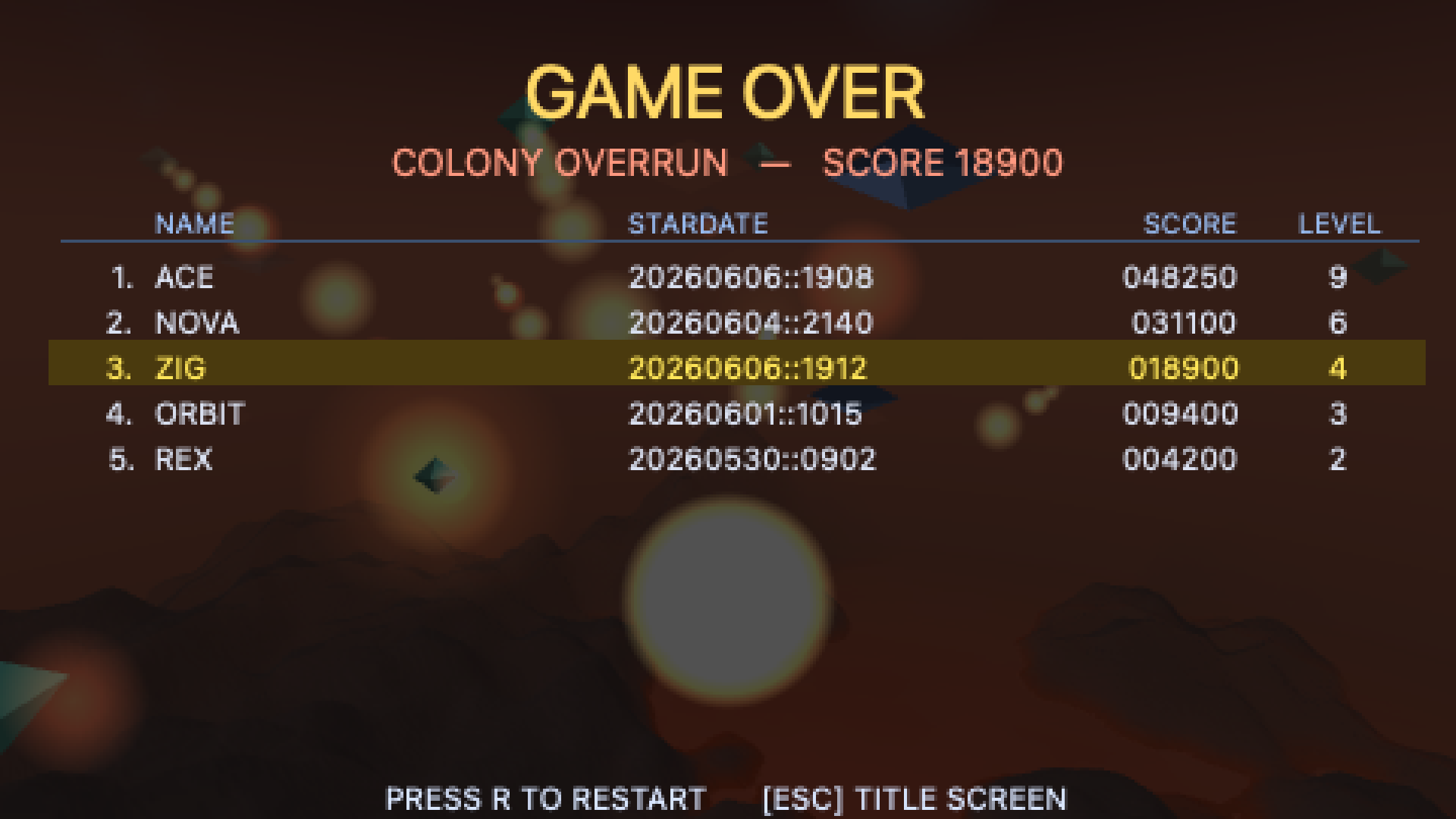
A persistent high-score table records name, stardate, score and level across sessions — the run ends when the last colony falls, and the board remembers how far you got.
Installation
Two formats on every release — both signed and notarised, pick whichever suits:
- Installer (
.pkg) — recommended for first-time installs. Double-click to run; macOS Installer placesStrataris.appin/Applicationswithout quarantine or App Translocation. - Download (
.zip) — unzip and dragStrataris.appto your Applications folder.
Or install it with Homebrew: brew install --cask perpetualbeta/jorvik/strataris
Auto-updates are handled by Sparkle, EdDSA-signed so your copy only ever installs genuine Jorvik Software releases.
Building from Source
Strataris is free and open source, and builds via the shared Jorvik release.mk. With the jorvik-release sibling repo cloned alongside it and GNU Make 4 installed:
- Clone the repo:
git clone https://github.com/PerpetualBeta/Strataris.git - Build the universal app:
gmake build - Run the freshly-built copy:
open .build/Strataris.app - Signed, notarised, stapled
.zip+.pkgready to ship:gmake release
Requirements
macOS 14 (Sonoma) or later. Universal binary (Apple Silicon and Intel).